Thursday, April 19, 2012

Snacking like a Cambodian

I am a big-time snacker. At my first office job, I used an entire drawer of a filing cabinet to store treats to get me through the day. In graduate school, I would pack my meals for the day of class/work and also include 3-5 snacks, resulting in the use almost of every piece of tupperware I owned. Over the years, I've come to notice that not everyone is a snacker or as avid a snacker as I, but there is instead a spectrum of snacking. On one end are folks like me, and on the other are those that wake up, eat breakfast and are just fine and dandy until the lunch hour rolls around. In addition to being impressed by people who aren't completely incapacitated by hunger at 10:30am, I am sometimes a bit embarrassed by how often I need to snack when in the presence of those that just simply don't.

A few months ago, two Khmer colleagues at my office were shifted to the room where I sit and I was pleased as punch to have some company around. We had all spent a week together in the field conducting a round focus groups, and I felt like we got along very well. But then I realized that they had no idea about my snacking. My previous officemate was also a 9-10 on the snack-scale, so we had a mutual understanding, but I didn't know where my new officemates stood. On our first day together, my stomach began to rumble on schedule at 10am, and I began munching nonchalantly on some crackers. A few minutes later, low and behold, my co-worker whipped out her own tupperware (from a bag of multiple snack containers) and we both snacked away.

Over the next few days, my officemate began to share snacking advice. She introduced me to her favorite snack foods, which were common snacks among Cambodians and completely new to me. Three of these items have since become staples in my snacking regimen.

Before introducing them, I should say that I have some selection criteria for good snacks in the office. Office-time snacks are different from movie-time snacks or bedtime-snacks, and these three snacks perfectly fit my criteria.

Criteria for a good work-time snack:

1) Not messy. Nobody likes a snack that contaminates a laptop or work papers.
Example: I tried to bring lychees in as a snack when I first got here. I L-O-V-E lychees, perhaps my favorite fruit. But my lord, they are messy. Peeling even one resulted in juice all over my hands, desk, squirted onto papers and into keys of my computer. Lychees quickly got the snack-axe.

2) Low odor. Again, nobody likes a snack that contaminates their airspace.
Example: I remember multiple officemates brining in tuna salad at my office in NYC, and while certainly a tasty treat, it can be a tad intense for those at the next desk over. Here in Southeast Asia, I've noticed a shared stance on the odor factor. In some hotels in Cambodia, there will be "Please no durian" signs (a fruit with a notoriously pungent, feet-like smell) and just this past weekend in Thailand I noticed that the stinky fruit is prohibited in subways.

3) Not too tasty. Come again?
That's right, I've realized the key to a good snack is one that isn't so delicious as to sidetrack you from work. Example: There's this place in town that makes brownies. These brownies are the embodiment of everything I look for in a baked good: sweet, varying in chewy and crunchy, and just ever so under-baked in the middle so you get the goodness of a brownie and brownie batter all in one. Early on, I bought one at lunchtime to nibble on as I crunched some stats in the afternoon. Around 2pm, I opened my brownie up, took a small bite and turned back to my laptop. And then my memory gets foggy.... all I know is the next time I looked at the clock it was 2:20pm, my brownie box was empty, I was licking chocolate off my fingers, and my laptop had gone to sleep. Bad snack choice.

TOP THREE CAMBODIAN SNACKS
1) Jicama/Bangkuang
- This is a strange, unassuming root vegetable. Before peeling, it looks like pretty unappetizing and even after peeling you might expect it to taste like a turnip or a potato. The first time my coworker offered me one, my expectations were low but now I buy them by the kilogram and eat them daily. The texture is just fantastic. A lot of crunch accompanied by some woodiness and a whole lot of water. It's kind of like a cross between a coconut and a water chestnut. And the taste is extremely subtle, mellow sweetness like a coconut and fresh like an asian pear. Several co-workers explained that this food is popular to eat in the dry/hot season as it is believed to cool down the body.

2) Guava/Tro Baek
- Looking a bit like a lumpy pear, this fruit is a popular tropical fruit flavor. Interestingly, when eaten raw it rarely tastes much like its replicated taste. I've seen small pink-fleshed varieties in India, but here in Cambodia they are fist-sized and white on the inside, with a taste verging on lemony-pear. These guavas also come equipped with very hard seeds at the center, which can break a tooth if you're not careful. Fun fact: A guava contains about 4 times as much vitamin C as an orange, making it nutritious and delicious.


3) Green mango/Svay Keo Lameat
-
Mangoes themselves are not a new fruit to me, but up until this year I had always eaten them very ripe, dark orange and very sweet. Here in Cambodia, a common snack is a green, less-ripe mango that is characteristically sweet and sour. The ratio of sweet:sour varies by mango, and I find that for most the scale is tipped more to the sour side. This mouth-puckering snack is often accompanied by a dipping powder, made up of chili spice, sugar and salt. This is definitely the most intense of the three snacks in my routine.

Okay, enough blogging. I need a snack.

Monday, April 16, 2012

Introducing: Mr. Shrimp


A few months ago my roommate and I adopted a kitten from a French couple who were moving on to Tanzania for work. They had originally found the little guy on the street, and he was so miserably flea-ridden that they called him "Sac à Puces," which translates to Sack of Fleas. By the time he came to live with us, he had overcome his pest problem and we bestowed him with an equally dignified name: Mr. Shrimp. He's a great Khmer kitty, who divides his days between napping spread eagle below the fan, cuddling, attacking feet and chasing plastic bags.

Sunday, February 26, 2012

Postcard from Cambodia


This video by Asia Media Lab has been circulating around the past few days; it's a captivating and thoughtful display of snippets of daily life across Cambodia. There are so many times I want to capture a moment in time here, and send it back home to share... Also, it's looking like my mom and her best friend are going to come out to this neck of the woods soon, so I hope this gets you both excited for your journey!

Wednesday, February 22, 2012

Another Dairy Adventure

A few weeks ago, riding a wave of confidence from my yogurt-making success, I decided to step up my game and try making another dairy favorite: ricotta cheese. Like yogurt, cheese is really not part of the local cuisine here in Cambodia, and as it is not readily available it can be quite expensive where it is sold.

During some routine data analysis at work the other day, I was able to quantify just how much dairy is consumed here compared to other food groups. One set of data showed that of 1,134 children, only 10.9% had consumed any milk product in the last 24 hours; whereas 99.6% had consumed rice, 94.8% had consumed fresh or dried fish, and 58.1% had consumed some kind of fruit or vegetable. Additionally, almost half of the families in this study reported that they never buy milk products. In comparison to other foods, dairy is pretty low on the scale of diet preferences for Cambodians. This makes a lot of sense given that, according to some studies,* lactose intolerance is more prevalent in this part of the world and milk is not traditionally part of the diet. I, however, am from the heavily cow-populated, dairy-obsessed land of the Upper Midwest. At the Minnesota State Fair, we have an entire building (okay, a barn) dedicated to dairy products. We have a Butter Princess crowned each year, who has her very own bust carved out from a giant block of butter. And then there is the All-You-Can-Drink-For-25cents Milk Booth. Growing up in this dairy culture, I definitely consumed a milk product at least once a day, much like most Cambodian children consume a fish product at least once a day, given that they grow up surrounded by streams, rivers and the ocean.

The idea of making ricotta was at first intimidating, but it is probably one of the simplest recipes I've ever followed. And unlike yogurt, you get to eat the results almost right away. To enjoy your own homemade ricotta, follow these simple steps:

-- Heat up 4 cups of whole milk + cream on the stove. You can use all milk, but the outcome will be less rich and creamy. And your milk to cream ratio should be no more than 1 cup cream : 3 cups whole milk.

-- Heat until the mixture begins to get frothy, kind of like a latte. Try not to let it boil. You can see how it is getting there in the picture above.


-- While you are waiting for the milk/cream to heat up, squeeze out 3 tablespoons to juice from limes or lemons. Make sure you don't have seeds in your juice.


-- Once your milk is hot enough, turn off and remove from heat. Pour in the lemon/lime juice and stir 2-3 times slowly and gently. You will start to see some curds within seconds.

-- Let the mixture sit undisturbed for 5 minutes. While it's sitting, line a sieve with 2-3 layers of cheesecloth and put over a big bowl.

-- Nest, pour the mixture (which is now curdled) into the cheese-clothed sieve. Let it sit for 1 hour. All the whey will drain into the bowl and you can throw this away. Some people keep their whey, but I'm still not sure what you can do with it. If you have any ideas, let me know!


-- After letting it sit, scrap ricotta from cheese cloth into container for saving, or eat right away.


* Sahi T 1994 Genetics and epidemiology of adult-type hypolactasia. Scand J Gastroenterol 202:720.

Sunday, February 19, 2012

Change in Plans: Crazy for Cambodia


I am coming upon completing my 7th month here in Cambodia, and time has been passing at an alarmingly swift rate. When I began this blog, I mentioned that this position would take me to 3 different countries over a span of two years, but there has been a slight change in this plan...

After arriving and discussing my work plan with the office here, it become clear that 6 months was a very tight timeframe to design/finalize research plans, collect data, transcribe/enter/clean/analyze this data, write up reports and present findings for several studies. Additionally, being here for 6 months would leave me with only 4.5 months in my next location, making it an even tighter schedule there. So, while I was incredibly excited about being in completely different geography for part of this year, it ultimately made the most sense for me to stay put.

This has turned out to be a fantastic decision because though all the data has been collected for the 3 studies I'm working on, I've only begun analysis and write-up. Additionally, I've fallen in love with Cambodia, the city of Phnom Penh, the projects I'm working on, and my co-workers. This is a truly beautiful and wondrous part of the world and I feel quite lucky to have the opportunity to be working here.

Thursday, February 16, 2012

Angkor Wat Run


A few years ago, I began running. This is a simple statement, but given my history of athletic misadventures it is actually something I am really proud of. And after completing my first 10K here in Cambodia, I feel like I can now actually call myself a runner.

I grew up with a lot of encouragement from my dad to get involved in "physical activities," but my success in these activities is pretty funny in retrospect. In elementary school, I played kickball and one game, when it was my turn to step up to the plate, I kicked the ball and broke my ankle. That's right, from just kicking the ball. In high school, I joined the softball team and played as left-fielder. My coach was wise as this position saw little action, so I was safe most of the time. But one game, the opponent's batter hit a grounder to left and it was a my make-or-break moment. The ball tumbled toward me, I picked it up, wheeled back my arm and threw... but let go too late and the ball went straight into the dirt about 2 meters in front of me. The next week I changed positions, and became the "team manager," where my organizational skills were much more beneficial to the team. And running had long been the bane of my existence. Every year of elementary school, our class had to run a mile and I just couldn't make it. We had to make 4 laps around the school, each time dropping a clothespin in a bucket to help us keep track. By the time I was a 4th grader, I was so over this exercise and decided to casually drop two clothespins in at once to reduce my distance. However, when I huffed and puffed across the finish line, first among my classmates, the gym teacher knew something was up. I ended up having to do that 4th lap anyway.

For as long as I can remember, my dad had always been a runner. I never really understood the appeal; he would suit up in his running shorts, shirt and a hat, tie up his laces and set out, only to come back beet-red, sweaty and out-of-breath. But one exam period during university, I was stressed and remember him telling me to try going for a jog to work out some of the exam anxiety. I began doing slow laps around the track at McGill's gym and soon realized I could now actually make a full mile, slowly but surely. And beyond that, my dad was absolutely right. Whether it was the distraction of focusing on just moving my legs one in front of the other, or the rush of endorphins that came from this action, running was leaving me feeling clear-headed and exhilarated.

I began to run more consistently about two years ago. Again, the stress of graduate school combined with an uncertainty about finding a job after graduation led me back to running as a way to "sweat it out." I would rise early in the morning and jog about 1.5 miles through Brooklyn, and come back ready to face the day knowing that I had already accomplished something that, for me, was not easy. It was empowering in a way I hadn't expected.

Before I landed in Cambodia, several people had told me about an annual half-marathon that is held amidst the temples of Angkor Wat in Siem Reap. Feeling like I might be ready to push myself further, I made a resolution to run the 10K portion of this race. My goals were clear: 1) Try to run the whole thing and 2) Try to make it in under 1 hour. And it's fills my heart with joy to say that I accomplished both these goals.

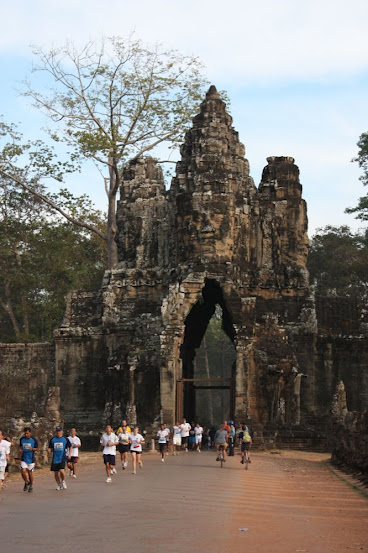
The actual run was one of the most amazing things I've ever done. Everyone lined up outside the entrance to Angkor Wat, and as the starting call was made we all began to move forward as a group. It was early in the morning, the sun had just come up, and the air was cool and damp. I looked to my right to see this incredible temple aglow in the light, and in front of me were a sea of heads bobbing up and down and a jungle beyond. As each runner began to find their own pace, the density of the crowd lessened and I found myself hearing nothing but my breath, the breath of those around me, and the scattered but consistent beat of our feet hitting the road. As if running past the awesome presence of Angkor Wat wasn't enough, our path took us through the gate into Angkor Thom, around the intricate, beautiful temple of Bayon, and beyond.

In addition to the setting, the atmosphere of the race blew me away. The event and all the proceeds are to raise awareness and benefit landmine victims, and many of the 10K runners were amputees running with prosthetics. And they were darn good, whizzing past me time and time again. And as the first runners began to loop back and pass all the runners who trailed them, everyone who was still working towards the halfway mark would cheer and stretch out their hands to high-five and encourage those in the lead. It didn't feel like a race, it felt like this random event made up of people from around the world, and everyone had joined together to complete the run. And this was highlighted by the fact that everyone got a medal, which read: Angkor Wat Run Finisher.* Finishing was what was important.

I get it now, why my dad ran. I'm hooked as well, and it's totally worth being beet-red, sweat-soaked and out-of-breath. :)

* Sidenote: When I got back to my hotel with this medal around my neck, one of the hotel staff ran up to me and said, "You won! You won!" For a split second I thought about saying, "Yes, yes I did!" But ended up letting him know that every runner got one, and I was, sadly, not the winner.

** Credit to the amazing Lucinda (who finished the 3K while 8 months pregnant!) for the photos from the race.

Monday, January 30, 2012

Bluegrass in a Tuk-Tuk


A couple days ago, I came upon a really fantastic website: The Tuk-Tuk Sessions. I have no idea who is behind this project, but according to their website, "the impetus behind this (project was) born out of a desire to play music and give the world a visual tour of life in Phnom Penh. We want to capture the bustling, vibrant streets of the Penh, accompanied by equally vibrant tunes, punctuated with the mandatory horns, moto revs and slight chaos." Basically, a musical person or group is found, put in a tuk-tuk, and they jam out while driving around Phnom Penh and the whole thing is filmed in one take. Pretty neat.

To give you a sense of what it's like to commute in Phnom Penh, I wanted to share one of the videos that was born out of the project fe,aturing a really great bluegrass band here in Phnom Penh, Grass Snake Union. To make it extra special, they are covering a song by Trampled by Turtles, an excellent bluegrass band that hails from Duluth, MN! Hope you enjoy the trip and tunes.

Sunday, January 29, 2012

Feeding an Addiction...

Sometimes I think I have a bit of an obsessive personality, mainly when it comes to food. When I find something I like, it seems like I can't get enough of it... When I was little, I distinctly remember going through phases of food: Caesar salad, kiwis, lemon-flavored Crystal Lite, hard-boiled eggs, baked potatoes, etc. Every time I went out to dinner with my family, Caesar salad was my order. Daytime snack? A kiwi of course. And when I started cooking a bit for myself, what was my daily choice for breakfast? Two hard-boiled eggs. The latter could very well have been the source of my sky-high cholesterol as a 12-year old, but I just couldn't get enough of those eggs.

Whether it's because I'm a creature of habit, or just a slave to my tastebuds, there are certain foods I adore and eat with regularity. Without a doubt, one of my biggest staples these days is plain yogurt. It's part of my daily breakfast, accompanied by honey, some oats and fruit; often mixed with a spoonful of jam as a mid-day snack; and my personal favorite, a great side for a spicy serving of most Indian dishes.

My love affair with plain yogurt first began in India. It's known as dahi there, and is the key ingredient for lassi, a kind of yogurt-shake that comes in both sweet and salty variations. The market near my old flat in Delhi had a dairy vendor, Mother Dairy, and each morning I would trot over to the market to hail an autorickshaw, and to pick up a 10 rupee take-away lassi for my ride in to the office. Up until this point, all my encounters with yogurt had been of the sweet kind, but in India I discovered it's amazing savory side. Yogurt was used to marinate meat, was the basis of raita (a side-dish of thinned yogurt with a mixture of spices and shredded carrot/cucumber/onion), and could be mixed with spicy green cilantro chutney and eaten with a curry. It was love at first bite for my tastebuds, and the rest is history.

Here in Cambodia, dairy is almost non-existent in local cuisine. Some children enjoy ice cream, but it appears that milk and yogurt are not commonly consumed. I've located a few sources of yogurt in the city, made directly by the source. Given that each small container can cost anywhere between $.50-1.75, my yogurt habit was really starting to add up. I had heard rumors that making yogurt was actually pretty straight forward, and so I thought I'd give it a go.

An old roommate in India had experimented with yogurt fabrication a couple times, but she had the advantage of an "auntie advisory board," a group of female relatives with decades of yogurt-making experience, and sage advice passed on from generations before. But not one to be discouraged, I had Google.

In my background research on yogurt preparation, I discovered some fun facts:

- The word "yogurt" is Turkish in origin, meaning to thicken or coagulate.

- Analysis of one strain of yogurt bacteria indicates that the first yogurt may have been created on the surface of a plant! And historians have found mention of yogurt as early as 500 BC, where it's combination with honey was referred to as "the food of the gods." I second that sentiment.

- One blog post compared making yogurt to making wine; each batch will taste slightly different from those that came before and those that come after, as the final product is a result of "infinite possibilities" of mixing milk, time, bacteria and climate.

- It's really all about the bacteria, also known as "active cultures." Some bacteria result in faster fermentation, and others are a bit slower. The faster the fermentation process, the more whey (the watery part at the top of a yogurt container) produced. Whereas slow bacteria results in a denser yogurt that incorporates the whey.

- Yogurt is pretty awesome for you. In addition being a great source of calcium, vitamin B-12, and protein, fresh yogurt fills your digestive tract with "good bacteria," potentially promoting immunity and healthy digestion.

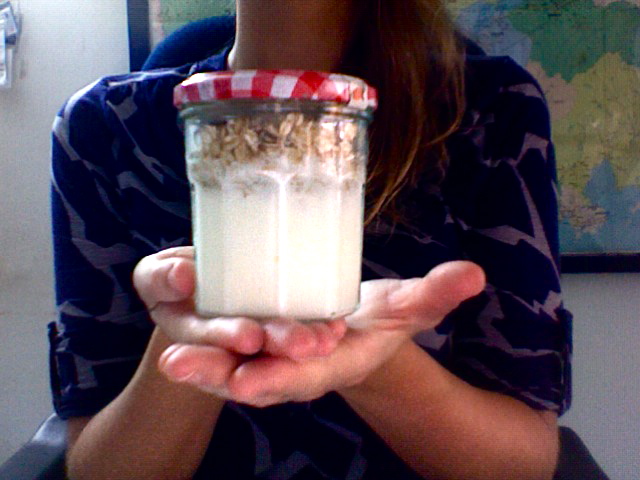
So how did it go? Surprisingly well. My recipe basically involved bringing one liter of fresh milk just to a boil, letting it cool, stirring in 2 tablespoons of plain yogurt with active cultures, and then letting it sit in a warm place to ferment. I forgot to let the boiled milk cool before adding the yogurt, and worried I had inadvertently killed the cultures. But after 8 hours of sitting in my hot apartment, my warm milk turned into a giant vat of yogurt. Success!

This morning, I took a jar of my fresh yogurt, with a dollop of honey and oats, in for breakfast at work. Deeeeeelicious!


Catching Up...

Oh, well, hello again.

So I know it's been awhile. When I began this blog, my intention was to be a "good blogger" and consistently post every 1-2 weeks, but unfortunately I ran out of steam mid-September. There was a reason for my withdrawal from the blog-o-sphere, but that is a post for another day.

Over the next few weeks, my hope is to get reaquainted with blogging and provide a catch-up on what's been going on professionally, personally, and of course, culinary-ily here in Cambodia.

I was back home in Minnesota a few weeks ago, and had more than a couple inquiries as to where my blogging went. The real clincher was when my Grandma (and inspiration for this blog's name) gave me a giant bag of Skittles for Christmas, after reading about my addiction to the candy here. My Grandma Mae doesn't have internet at home, so my aunt prints out the latest posts and brings them over so my grandparents can read them. It hit me that this is what this blog is all about, being able to be in better touch with my loved ones, and share a bit of my life while I'm far away. So, Grandma, and other readers, thanks for reading, for the encouragement and support, and without further ado: "Soup's on!"

Tuesday, September 27, 2011

Exercises in Green Thumbery

After visiting so many incredible homestead gardens across Cambodia over the past two months, I started to crave a little garden time back at my apartment in Phnom Penh. My own green thumb is quite inexperienced; last summer I grew some basil, chives and a tomato plant, that latter of which only yielded two tiny fruit. But with a great deal of enthusiasm from my roommates, planting season has begun in our home. We've potted a few flowering plants, along with several herbs and are even trying for a fruit tree. With rainy season in full force and a plethora of greenery to now call home, a troop of giant snails have moved into our garden space!

Tuesday, September 20, 2011

What IS empowerment?

Sometimes things in development are foggy, specifically the jargon. There are a lot of terms that pop up in proposals, mission statements, and reports that carry a lot of weight among development folk, and a lot of time and effort is spent developing these phrases in order to pinpoint a very specific concept. My last semester in graduate school, I read a WorldBank report on "quiet corruption," a term coined to speak about corruption that occurs at the frontline of development programs in education, health and other sectors. Often when people speak of corruption, we imagine powerful men in big institutions, counting giant stacks of illegitimate money. I remember reading this paper and knowing exactly what this "quiet corruption" looked like (nothing like the stereotypical type), what detrimental effects it can have on a health system, and how the root causes are so vastly different from what we typically think of as corruption (the causes aren't as cut and dry as greed and hunger for power, it's often about lack of support and adequate compensation). It was a challenge I had seen time and again in different settings, but had never thought about in such a structured manner. So sometimes, jargon in development can help to clarify and categorize things, and maybe allow for better solutions to certain problems.

And while I honestly believe that these terms are always developed with the best of intentions, sometimes they end up being just plain confusing. Sometimes to the point of hilarity. What IS
capacity building? What does it MEAN for a program to be sustainable? And currently, my own professional challenge: What IS empowerment??? A friend forward me a link last night on exactly this fogginess, and while it made me chuckle it also reassured me that I'm not alone in my frustration. Compiled by the development economist, Will Easterly, the AidSpeak Dictionary lists the main buzzwords in development, along with a tongue-in-cheek definition offered up by various people working in the development sector.

Some are pretty amusing:
“experienced aid practitioner” : has large number of air miles in account

“field experience” : I can’t bear DC anymore

“innovation” : we’re sexy, you want to be associated with us

“sustainable” : will last at least as long as the funding

But it was this one that hit too close to home:
“empowerment” : what is left when all the quantifiable variables give non significant results

One of my main projects at The Org is to identify how The Program may lead to improved women's empowerment among participants, and how this in turn may lead to improved maternal and child health and nutrition outcomes. Sound straightforward? Nope. As it turns out, "empowerment" has become quite the hot topic in development, with funders excited to support programs that foster "empowerment," and therefore, organizations excited to define components within their programs
associated with "empowerment." But the task of actually studying "empowerment" for one of these organizations is really, really tricky.

First, back to my initial quandary,
What IS women's empowerment? Conducting a brief literature review on the subject (well, 14 pages single spaced...) revealed that academics are also somewhat at odds over what to call it (you say autonomy, I say agency, etc.), but that most agree that empowerment relies upon the idea that a process of change occurs, whereby one moves from a state of disempowerment to a state of empowerment, and that this process occurs through human agency (Malhotra, 2002). The ability to become empowered is therefore dependent on the ability of an individual to make choices, and through this increase in ability to make choices and the act of choosing one becomes empowered. Which is especially interesting when you think of how many programs talk about empowerment as something they will provide ("This program will empower women/adolescents/minorities/etc"), but really empowerment comes from within an individual and can not be created by an external force. This all seemed pretty straightforward, until I starting digging deeper...

Next quandary, What leads to empowerment and how on earth would you measure this? This literature on this was a bit more discouraging. Most scholars argued that given the very definition of empowerment as a process of change in human agency over time it may not even be possible to measure empowerment; since it's a process one has to measure at several points in time, and since it's a change indicators will also evolve over time so one may not even be able to use the same indicators at each measurement! PLUS, it's argued that empowerment indicators are entirely context specific (what looks like empowerment in NYC is not what empowerment looks like in Cambodia), so it's difficult to standardize empowerment and compare levels of empowerment across regions. Sigh.

Despite this, The Org and I are going to try. I've identified some interesting indicators for empowerment, am finalizing the research tools, and beginning next month the data collection will commence. Because so much of this is exploratory, part of the process is finding out not only how The Program relates to women's empowerment, but also what are the appropriate indicators to measure it in this setting. I'm excited to see what we discover. And despite AidSpeak Dictionary, maybe just maybe, these empowerment variables will be significant.

Reference: Malhotra A, Schuler SR, and Boender C. 2002. Measuring Women’s Empowerment as a Variable in International Development. Gender and Development Group Working Paper. World Bank.

Friday, September 16, 2011

Birthday in Kampuchea: Cooking Class

A few weeks ago, I celebrated my 28th birthday in Phnom Penh. It happened to also be the birthday weekend of several other friends here. In NYC, early September was always a parade of birthday parties and festivities as well, leading me to believe that I either tend to gravitate towards other Virgos, or there really is just a larger proportion of New Year's Eve babies out there than most of us realize. :)

This birthday was absolutely lovely, and it was fantastic to share it with some great people I've met here. Some highlights included a delicious chocolate cake prepared by my roommate, a fantastic (vegan!) khmer dinner with friends, watching a friend who works in water-sanitation present on parasites at "Nerd Night" (a event in Phnom Penh where nerdy, curious people come together to watch peers give 20-slide, 20-minute presentations on the topic of their choice), and my purchase of a glorious, comfy muu-muu for sleeping. I even got a dollar off because the vendor found out it was my "special day." But maybe the best part of this day was the incredible outpouring of birthday wishes, updates and hellos I received from friends and family. I miss you all so much and hearing from you was such a treat.

As a birthday gift to myself, I enrolled in an all-day cooking course, to master the art of cooking khmer (or to at least understand some basics). Bright and early at 9am on a Saturday, two friends and I began the day with a market tour; our cooking instructor lead us through the maze of stalls, stopping here and there to introduce us to all the leafy greens, bright fruits, edible flowers, tubers, chilies, noodles, dried/smoked/fermented meats, and more. At one stop, we tried more than 3 types of basil (each tasting distinctly different) and one unique herb, fishwort, that actually tasted.... fishy.

After our market introduction, we gathered all the necessary provisions for our lesson, and headed to the cooking school: a rooftop classroom equipped with stove top stations, cutting boards and gigantic wooden mortars and pestles. For the next 5 hours, we chopped, ground, marinated, tossed, and steamed our way through four delicious dishes. First up: fried spring rolls filled with taro and carrot. My only prior experience with taro has been in bubble tea form, so I was pretty excited to see how the cooked root vegetable tasted. Our instructor ran a tight ship, and any spring roll not rolled in perfect formation was rejected for frying; we later found out that a perfect roll was not only aesthetically preferably, but prevented oil from entering inside and kept the stuffing fresh and light, rather than mushy and oily.

Second up: fish amok. This is one of the first dishes I had in Phnom Penh, and is a Cambodian classic. Essentially, it is a coconut-milk based curry with fish, and prepared by steaming everything inside a banana leaf cup. Making every part of this dish by scratch involved grinding up kaffir lime rind, galangal (looks like ginger, but a more mellow biting flavor), lemongrass, garlic, turmeric, shallot, and red chilies in a mortar and pestle until smooth, adding coconut milk to this kroeung (a traditional herb paste made of these 7 ingredients), and marinating tiny chunks of fish fillet in this curry sauce so the flavors are absorbed. Next, you fashion a small cup out of fresh, young banana leaves and about five toothpicks. Our instructor's expectations for his pupils' performance on this task, like the spring rolls, were high. We each struggled to manipulate the stiff leaves and flimsy toothpicks, and probably went through four or more iterations of a cup until one was deemed satisfactory for fish amok. This tiny cup was then filled with our curry and set in a steamer for 30 minutes. During this time, we sat around, sipped Angkor beer with our instructor, chatted about food and life in Cambodia and then... we ate! Fish amok is one of my absolute favorite things to eat here. It's a lighter coconut curry than most, and the steaming process keeps the flavors bright and the fish texture very lovely.

Third up: banana bud salad with chicken. This delectable, raw salad's main ingredient is the bud of a banana tree, which is sort of like a tender husk. We finely julienned a few leaves of the bud, along with red pepper, coriander, mint, and basil, and added shredded poached chicken breast. We topped it off with crushed peanuts, lime juice, and a dressing of fish sauce, red chili, garlic, palm sugar and more lime juice. The banana bud is probably most similar to cabbage in texture, but the flavor is very neutral, with just a hint of sweetness. Another definite winner.

Last up: sticky rice and mango. This has long been a favorite food of mine, and for some reason I held fast to the belief that sticky rice is difficult to make. I assumed it involved at least 1-2 special piece of kitchen equipment that I would never own, involved a long and arduous cooking process, included coconut milk and perhaps other ingredients not readily available in North America, and a very special type of rice. I was only correct on one of these assumptions, and only partly. Cooking sticky rice does require a certain type of rice, but I wouldn't necessarily call it special; it's simply a more glutenous type of rice that becomes, well... sticky during cooking. So, we just added this rice to boiling water and let it cook. Easy peasy. While we were waiting for the rice to stick-ify, we chopped up some mango and prepared a finger-licking delicious sauce of palm sugar, butter, and coconut milk. This is perhaps the most easy and delectable dessert I've ever made. All in all, a day well spent!

Tuesday, September 6, 2011

Khmer amazes again...

I've been plugging away at my Khmer language skills over the past few weeks, and after 3 lessons I am now able to (sort of) direct tuk-tuks, make purchases in the market, and enter into conversation -but I'm still at a loss for what to say beyond, "How are you?" All in all, my progress has been slow but steady!

I don't know if Khmer will stay with me beyond my time in Cambodia, but it's definitely left an impression on me in terms of how interesting languages can be. I mentioned in a previous post how much I loved the vocabulary of Khmer, and how words are often compounds of smaller words. When you are learning vocabulary, it's easy to focus on just memorizing the words, but the real enjoyment comes when you actually begin to understand the meaning of each part.

Here are a few of my recent favorites:

chol chet = to enter the heart (to like)

- So when you say you like something, you are actually saying that this thing enters your heart. Swoon!

kit luy = think of money (the bill)

- So when you request the bill at a restaurant, you are requesting to "think of the money." And when something is free, it's "ot kit luy," or "don't think of the money."

Finally, one of my new favorite (and very useful) words is: chngan (delicious)

- I love this word simply because it's so fun to say. It's very nasal and you don't open your mouth much say it... so it's actually kind of similar to when I say, "Yuuummmmmm!"

Monday, August 29, 2011

Pick Your Poncho!

I really misgauged rainy season here.

Poor assumption #1: In India, the monsoons run from early summer through August, and meterologist I am (not)... I assumed the same would be true for Cambodia. Silly, silly me. Once I arrived, I started hearing about how rainy season was just beginning. And how it lasts through September, no wait, through October, well actually it went into November last year... I'm still pretty unclear on how long the rains will last, but they have begun. It usually rains every day, and this can start mean a light drizzle, a solid rainfall, or a downright white-out pour. Luckily for me, I love it when it rains. I've noticed that listening to raindrops on a roof and watching the earth become washed is one of the most comforting things to me. I got this feeling the first time I was experienced the monsoon in Delhi, and now I get the same feeling everytime. I think it stems from the fact that with eyes closed, rain, the sounds and smell, is the same everywhere in the world. So when it rains I could be at my parents' house in Minnesota, or up at Lake Superior, or in a field station in Nigeria and my sensory memory triggers the same way... and I weirdly feel like I'm at home. Wherever that is.

Poor assumption #2: In both India and Nigeria, when the rains came, no one went outside. It was accepted that if the heavens opened, you would stay in your home/office/shop until it subsided. How long depended on the length of the pour; it could mean 15 minutes or a whole day. And because the rains would flood the streets and make travel nearly impossible, sometimes trips to the field would have to be rescheduled for another day. Again, I assumed Cambodia would also follow this unspoken rule and that I would never really be exposed to rain that much. People have often asked me if I take rainboots with me to monsoon-prone places, and I never have because I don't really venture out into deep puddles. So this time, I also didn't bring a raincoat or umbrella (this is also because I needed to make room for Skittles and extra gummy snacks, which I deemed more useful/necessary than rain gear). Silly, silly me. Cambodians' motto: Rain? Rain, shmain! When the showers begin here, most people really only seek shelter if it's raining so hard you can't see the road in front of you. And because I tend to walk/cycle everywhere, I am often caught in the rain while in transit. Knowing that weather isn't really a valid excuse for tardiness, I have been pedaling/strolling to arrive at my destination, soaked but on time. After lamenting my poor choice of candy over an umbrella, I decided to follow the local custom here and pick up my new best friend: my poncho. Everyone here has one. They cost about 25 cents, come in almost every shade of the rainbow, and have the consistency of an extremely thin garbage bag. When drops start to fall, everyone pulls theirs out, crawls in and carries on. The roads begin to look like a watery Monet of easter eggs, with motorcyclists blearing by in lilac and baby pink, bicyclists in sunny yellow and lemongrassy green, and me in my own sky blue version, all puffed up with air gusts. Which color egg would you be?

Sunday, August 28, 2011

Field Sentiments


This past week I took a trip to one of the regions where The Org is operating its agricultural/nutrition program. Along with a fellow barong (foreigner) co-worker and Thida, a Cambodian program officer, I made the 4-hour car journey to Pursat province to monitor and observe various aspects of the program. Over the past month, I've read countless studies, bulletins and reports, and to see the farms in action took my breath away... Working in development, or public health in general I should say, I have often been part of programs that are innovative, exciting and that on paper should work perfectly. But in the field, whether that be New York City public schools or a village in rural India, challenges pop-up in the most unexpected places and programs have to weather these bumps in the road. So as we zoomed through the countryside, I held the picture-perfect version of the program in my head, but also kept an open, curious mind for what the challenges would be in this setting.

As we hopped out of the car and walked up to meet the first Village Model Farmer, I got a feeling in my gut that this visit was going to be different. His face stretched wide with a smile as he saw Thida, who visits all the farms each month to see how things are progressing. Thida has a background in both agronomy and management, and over the course of two years of field visits she has built an incredible rapport with each farmer. They greet one another as good friends, discuss how all the crops are coming along, and Thida gives suggestions for increasing production and planning ahead for the next season. The farmer took us on a tour of his land, pointing out different crops, animals and explaining his plans for the next planting. His farm was flourishing, with lush rows of mustard greens, morning glory, bunching onions and trellises crawling with gourd and bean vines. In another section, he showed us all the seedlings and saplings he was growing and saving, to be distributed among the other household farmers in his community. As a Village Model Farmer, he serves as a source of agricultural knowledge and support for the 20+ women farmers also participating in the program. If someone's sweet potato plants aren't doing so hot, they'll come to him for tips on how to turn things around. He also talks with the other farmers, most of whom are mothers of small children, about the nutrition of these crops and the benefit of including them in daily meals.

I left his farm overwhelmingly impressed by the food production, his pride in his work, and his commitment to supporting others in the village. As we moved on to visit household farmers and more Village Model Farmers in other villages, I continued to see a pattern.... Beautiful, successful garden plots, farmers beaming with pride, and women saying over and over again, "Yes, we get all our vegetables from this garden so we don't have to but at the market. And whatever is leftover we sell at the market, and then we spend this money on meat and school fees for the children." When we asked if they also spent some of the money on healthcare for the children, only a few said they did... The rest said that since they began feeding their children more fruits and vegetables they had actually been sick less often, so no, they didn't need to spend the extra income on healthcare.

Part of me knows that I am probably still a bit naive, and haven't seen all the ins-and-outs of this program. We were visiting a program that had been operating in Pursat for almost 2 years (and the program has been in Asia for over two decades now) and there were most likely some hiccups throughout during implementation, but overall this program is working in Pursat. Numbers show increases in food production, income generation and after endline data is gathered we will see if there have also been increases in consumption of micronutrient-rich foods and improvements in child health and nutrition. The program is ending in October in this region, but every farmer we met was preparing beds for their next planting, planning their next harvest, and collecting and saving seeds for the next season... When we asked if they would continue their farms after October, all responses were the same and the answer was evident in the success of these farms, the smiles and energy of the kids, and the stories of how lives had changed over the last two years, "Yes, of course we will continue."

Saturday, August 27, 2011

A Brief History of... The Program

With work getting busy and field visits happening, I have a feeling that more and more of my blog posts are going to be work-related... So I thought it would be helpful to give a bit of a primer on the program I'm working on for the next 6 months. This was taken from a bulletin by The Org and sums up the programs operations and objectives quite nicely!

"The Homestead Food Production Program targets women from poor households as the primary beneficiaries, placing farming inputs, knowledge and skills in their hands. The Org works in collaboration with local partner NGOs and government structures to establish Village Model Farms (VMF) and also helps household to establish home gardens (cultivation of vegetables and fruit crops around the house) and small animal husbandry, mainly poultry... The Org and partners promote 'developed gardens,' which produce a wide variety of vegetables and fruit on a fixed plot of land throughout the year. This model relies on the dedication of participating households, particularly owners of Village Model Farms (VMF). The model also builds linkages with local health and agriculture structures to provide additional services to participating households and builds capacity of local partners to provide sustained technical assistance on both agriculture and nutrition to both VMF owners and beneficiary homestead food producers after the life of the three year project cycle.

The VMF serve as a place for training and demonstrations on improved agricultural techniques, technologies and poultry production activities for households participating in the program. The VMF is also used a a production center, as it is a source for inputs, like low cost quality seeds, seedlings, saplings and chicks. VMF owners are responsible for sharing these new practices and low cost inputs with other households in the village and providing ongoing support in collaboration with The Org and local partners. Typically about 20 households are supported by one VMF and households are divided into two smaller groups (women's groups) to best facilitate collaboration.

Nutrition education is a core component of the Homestead Food Production Program. The Org and local NGO partners train health staff and volunteers working at the village level, who in turn host nutrition education sessions for mothers. These sessions emphasize the importance of eating nutritious food during pregnancy and lactation, as well as educate mothers on optimal feeding of infants and young children, including breastfeeding and complementary feeding. Mothers learn how to improve their household's dietary diversity and micronutrient consumption through cooking demonstration sessions using locally grown foods. More recently, the basic nutrition education component has been enhanced to include essential nutrition actions and behavior change negotiation for improved nutrition practices among mothers.

The Org and local partners provide all necessary inputs at baseline to VMF and households, including: 10-14 vegetable and fruit seed, seedlings, and saplings, chicks, poultry vaccinations, and training on optimal crops and cultivation, composting and organic pest control, water management and conservation, garden fencing, chicken shelter construction, vaccines and feed production."


Saturday, August 20, 2011

Food Round-Up: August

Phnom Penh is delicious. Someone recently asked me what I've had here that has been especially good, and after rattling off everything I've tried so far, I realized it's probably a lot easier to just say what hasn't been good (which was only a grilled cheese on Day 2 made with liquid nacho cheese). Because I love food, and I know lots of you do too, I am going to try to share a few of my favorite discoveries with you each month. A lot of my eating has been spontaneous, so unfortunately I don't have original pictures for this post but will try my hardest to start keeping my camera attached to my hip for such occasions.

Near my house, there are two insanely yummy, cheap Khmer restaurants. One is more of a mom-and-pop establishment, with Khmer boxing playing on a giant TV and kids racing around the tables. One of my first days here, a friend introduced me to Lok Lak. This is a very common, traditional Khmer dish of marinated, grilled beef served with rice and a salad of cut up raw veggies. Not only is the meat incredibly tender, juicy and flavorful from soaking in soy and oyster sauce, you get a dish of ground up Kampot peppercorns and salt, to which you squeeze in lots of fresh lime and use as a dipping sauce. The combination of sweet meat, intense salt, fragrant pepper and zesty lime is absolutely mind-blowing. Definitely one of my favorites.

The other neighborhood restaurant is a bit more happening, with a younger, more rambunctious crowd and parked motorbikes fill the street outside most nights. "Beer girls" quickly ask you what type of beer you'd like for the evening (Angkor, Anchor or Tiger?) and keep your glass constantly full. Sidenote: people often drink their beer on ice here, something that I snobbishly resisted at first, but now find totally refreshing on a hot steamy evening. At this place, I tried Pleah Saiko, which is a cured beef salad of raw beef, lime, lemongrass, red chilies, cilantro and basil. The flavor was incredibly fresh, spicy and the beef had a nice mellow taste.

Another one of my favorites here is actually one of my favorite meals in general: Som Tum and sticky rice. This salad is a mixture of raw julienned green papaya, mint, green beans, red chilies, lots of lime and peanuts. In Cambodia, this is called Boklahong, and it's also served with lots of tiny dried shrimp and chunks of black river crab that you eat shell and all (these actually hurt my teeth, so I have to extract them). Back in NYC, Asian cuisine is usually my go-to for dinners out. I love pretty much all things Thai, Vietnamese, Korean, etc. Here in Phnom Penh, I get to try out my favorites and have been exposed to countless other dishes that I never knew existed.

One day for lunch, I ventured into a Vietnamese restaurant and when I realized everything was in Khmer/Vietnamese I was at a loss for what to order. I knew I wanted something new, so picked out something unfamiliar and the restaurant owner took me into the kitchen and showed me what went into it: vermicelli rice noodles, fresh chopped lettuce and cucumbers, grilled pork bits, peanuts, chunks of fried spring rolls and bean sprouts. All in one bowl, this is Bun cha. I added a thin, sweet sauce loaded with more red chilies and it was a scrumptious lunch.

Finally, I had read about this Chinese restaurant called Fisherman Quay on a Phnom Penh food blog I recently began following (Nyam Penh). I dragged a group of friends along last Friday night and we sampled some delicious Peking Duck. I've actually only had peking duck once before, in Flushing, Queens, in a bun, which was also delicious. Here, the duck comes sliced and you put a piece or two inside a crepe-like pancake, along with cucumber, green onion, pickle and a dollop of hoisin sauce. The duck was fatty and yummy and excellent paired with the fresh veggies and light pancake wrapper. Will definitely be back for more.

That's it for August. Quite a delectable month.

Thursday, August 18, 2011

Combatting the Distance... with an Egg?

Despite how excited I am to be here, how much I am loving work, and how amazing Cambodia is... the distance from home stinks. I stumbled upon this and had to share. Do you think it would still work between NYC and Phnom Penh? :)
Created by the Design Incubation Center in Singapore, "Roly Poly is designed to enable two individuals to “sense” the presence of each other even though they may be physically apart. The mirrored movements in a pair of Roly Polys is such that a soft tap to rock one will simultaneously rock its partner to the same degree, creating a corresponding reaction in the other instantly."

A Flair for Khmer

Yesterday morning, I had my first Khmer lesson. After living in Montreal for 5 years and never learning French until 8 months ago in NYC, and then living in India for 1.5 years and only picking up enough Hindi to get around in an autorickshaw and bargain hard at the markets, I have resolved to make my way to at least conversational Khmer while in Cambodia. Khmer is the official language here, and a quick Wikipedia search revealed the following fun facts:

- It is the second most widely spoken Austroasiatic language, after Vietnamese, with over 10 million speakers

- It is heavily influenced by Sanskrit and Pali

- Unlike other languages in this part of the world, Khmer is not tonal, meaning that pitch does not change the meaning of words (thank god for me!)

Granted I've only had one lesson, but I love this language. For one, it's so much fun to speak. The intonations and speech patterns are so dissimilar to any language I've ever spoken before, so I feel like my voice is breaking out of a realm I never new I was in. The pace is sort of a rush of the first few words and then a drawing out of the last... and there are a lot of nasal tones (which makes this Minnesotan feel right at home). It almost reminds me of learning tennis as a kid; I would keep swinging my arms and placing my feet in the hopes that eventually these awkward motions would produce the desired stroke, and eventually my body's phyiscal memory kicked in and it just became automatic. As I learn Khmer, my lips, tongue and mouth all keep working awkwardly and, hopefully, soon the words will flow effortlessly.

And then there are the actual words. My teacher taught us some basic nouns this week, and when she directly translated them I knew I was hooked on Khmer. Here are two of my favorites from this lesson:

- puah wian kang = intestine of a bicycle (bike tube)

- teuk dah keo = liquid from the breast of a cow (milk)

Finally, here's a little video so you too can hear and enjoy Khmer:


Sunday, August 14, 2011

Phnom Penh City Timelapse


This video has been popping up all over here in Phnom Penh, and I just love it. I don't know who actually shot it but here is what they posted on YouTube:

"Phnom Penh is a city moving into the 21st century at an astonishing rate. Western technological and social influences are creating a highly contrasting society between those who embrace change and those who can't or won't. Where the west had decades for society to progress in parallel with technology, Cambodian people are trying to squeeze that progression into just a few years. This video represents the pace at which the city is changing."